Licensed program?Facilitator sign-in
The Short List Reunion Course For graduates of any fatherhood program
Session 6 · Healthy relationships lane

Stop Keeping Score

Why a running tally keeps the kids’ week stuck, and how to turn one grievance into one proposal.

License this sessionLook insideSee all nine sessions
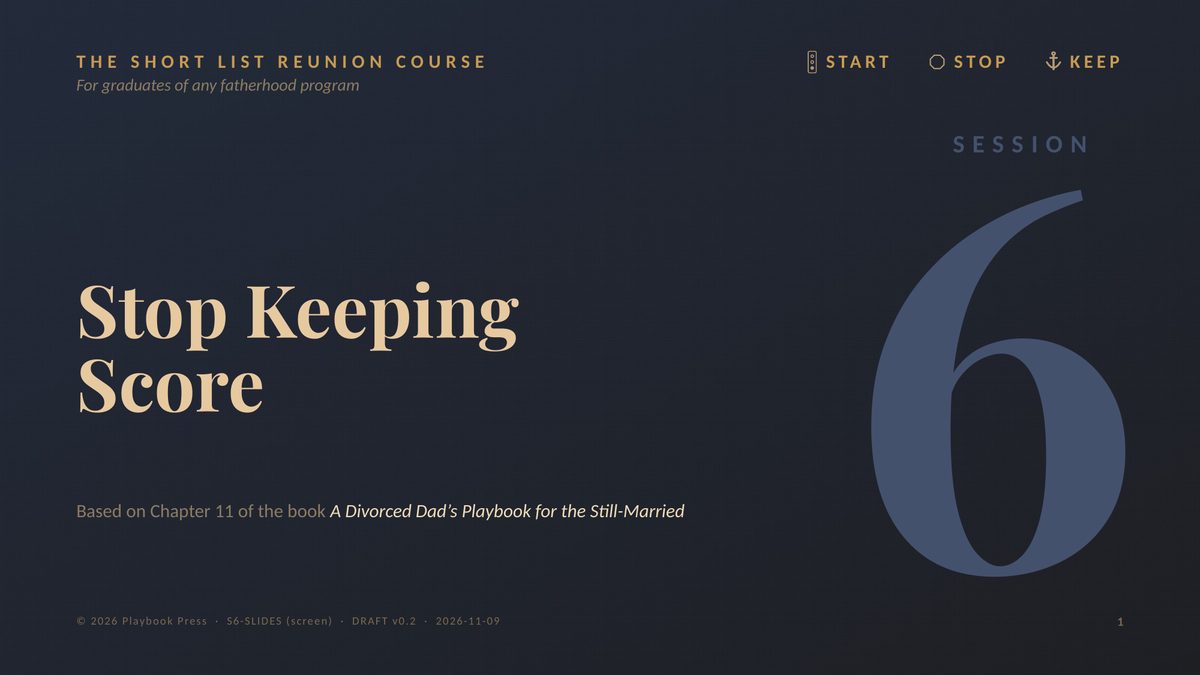
Title slide for Stop Keeping Score
SourceChapter 11Of the book
Length90 minutesOr 60, or 120
Room8 to 20 menIn person or virtual
ScenariosSix kinds of roomOne set picked for your men
The one idea

A scoreboard only tells you who’s ahead.

It can’t tell you how to get anywhere.

Between two houses, the only score left is the kids’ week.

Scenarios · why it lands

Six scenarios. One for every kind of room.

Every session carries six short scenarios, each written for a different kind of room. Your men hear a situation that sounds like their own week: the child support order, the first weeks home, the overnight shift.

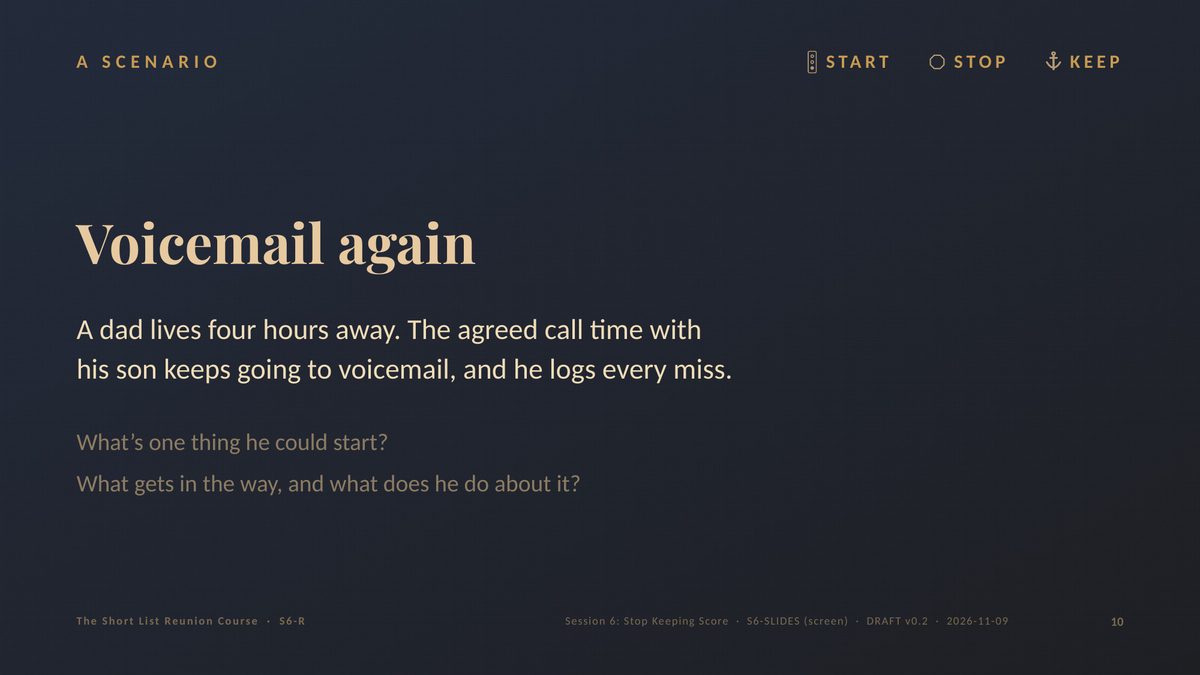
Your site picks the set that fits its men, once. The facilitator reads it right after the teaching, and the room works it together: What’s one thing he could start? What gets in the way, and what does he do about it?

Distance and rural Voicemail againA dad lives four hours away. The agreed call time with his son keeps going to voicemail, and he logs every miss.
Child support and the courts Where the money goesRead-aloud and facilitator notes in the kit
Home from jail or prison Every decision without meRead-aloud and facilitator notes in the kit
Home from treatment Who owes whomRead-aloud and facilitator notes in the kit
Work and schedules Always the one who swapsRead-aloud and facilitator notes in the kit
General The jacketRead-aloud and facilitator notes in the kit

Every scenario is invented for room discussion. None is a real person’s story.

The research

Why it works.

01The ledgerNeutral moves start to read as hostile.
02The example“What time will you be home?” lands as an accusation.
03ForgivenessLetting go isn’t a blanket good.

Sources: Weiss; Gottman on negative sentiment override.

In the room · 90-minute version

What dads do in this session.

Welcome5
Teach25
Write20
Talk20
Commit15
Close5
1Write
20 min · silent, on his own page
  • Part 1The score you’ve been keeping
  • Part 2Choose the one that fits your house
  • Part 3Turn it into a proposal
2Talk
20 min · in pairs, then the roomRead your partner the proposal. Not the grievance.Eight minutes. Make it more concrete together: who, what, by when.
3Commit
15 min · the Short List cardOne Start. One Stop. One Keep.“I’ll stop arguing with her” is a wish.“Two weeks’ notice on swaps, on Sunday’s call” is a plan.
Key lessons · from Chapter 11

7 tools. Each dad picks his first.

Start
  • Own Your Part FirstWhen it gets heated, apologize for your piece and bring the temperature down.
  • Make a Proposal, Not a Case
  • Clear the Agenda
  • How to use them: in the kit
Stop
  • The LedgerTallying who’s meaner, who works harder, who owes whom.
  • Choosing to Be Right
  • How to use it: in the kit
Keep
  • The Win-WinHunting for the version where you both come out ahead.
  • Grace for Yourself
  • How to use it: in the kit

He leaves with one Start, one Stop and one Keep on his Short List card. Every tool, and how to teach it, is in the Facilitator Kit.

Look inside

A sample of the materials.

Sample page
A scenario slide, matched to the men in your room. Your license includes slides in two versions: this dark one for the screen and a light one that’s printable.
Who it fits

Three ways programs can run it.

1·Graduates
A reunion group after the core curriculum ends. Built for men who finished any fatherhood program.
2·First-timers
A first group for dads who aren’t ready to commit to a full program yet. Nothing in it assumes he finished a class.
3·The healthy relationships lane
Runs on its own, or with the other two sessions in its lane.
How it closes

“Stop keeping score. Get out of the ledger. Trade the argument for a proposal, and the scoreboard for the outcome.”

License it

$49 a session, $99 for the healthy relationships lane or $199 for all nine, per facilitator, per year. Founding programs run their first class free. See full pricing

Previous · Session 5← Say the Good ThingNext · Session 8The End of Mind-Reading →